Loading…
Clinical guide03 Jan 2026 · Updated 13 Sep 2026 · 6 min read
Rotary files separate for two reasons: cyclic fatigue from rotating in a curve, and torsional overload when the tip binds while the shaft keeps turning. Prevent both with a glide path to working length before any rotary file, the motor speed and torque the file maker specifies, a light pecking motion with irrigation, heat-treated files in curved canals, and a firm limit on how many times a file is reused.
A rotary file breaks in the apical third of a curved molar canal. The next hour is spent trying to retrieve it; the next month is spent working every canal more slowly than necessary. Nickel-titanium rotary instruments have made canal shaping faster and more consistent, and they break for reasons that are well understood and largely preventable. This guide explains the two failure modes, the routine that prevents them, how the file systems we stock differ, and what to do when a file does separate.
A file rotating freely in a curved canal is bent once every rotation. Each bend loads the outside of the curve in tension and the inside in compression; the metal accumulates fatigue with every rotation until it cracks, usually at the point of maximum curvature and without warning. The tighter the curve, the larger the file diameter and the longer the file spends rotating at the same spot, the sooner it fails. Fatigue is invisible: a file can look perfect and be one rotation from fracture.
If the tip of the file binds in dentine while the motor keeps turning the shaft, the file twists. Beyond its elastic limit it deforms, unwinds and shears. This is the failure of a file forced into a canal that has not been pre-enlarged, of a file pushed apically with pressure, and of a motor whose torque limit is higher than the file can bear. Unlike fatigue, torsional stress often leaves a warning: an unwound flute or a shiny area.
| Class | Stocked examples | Role in the routine |
|---|---|---|
| Hand K-files | Dental Perfect stainless steel K-files, sizes 6 to 15 in 21, 25 and 31 mm; EndoEdge and Thomas K-files | Scouting and the first glide path |
| Path files | IMD MPro Smart Kit (path files 10 and 15 with small rotary files) | Mechanical glide path after the hand files |
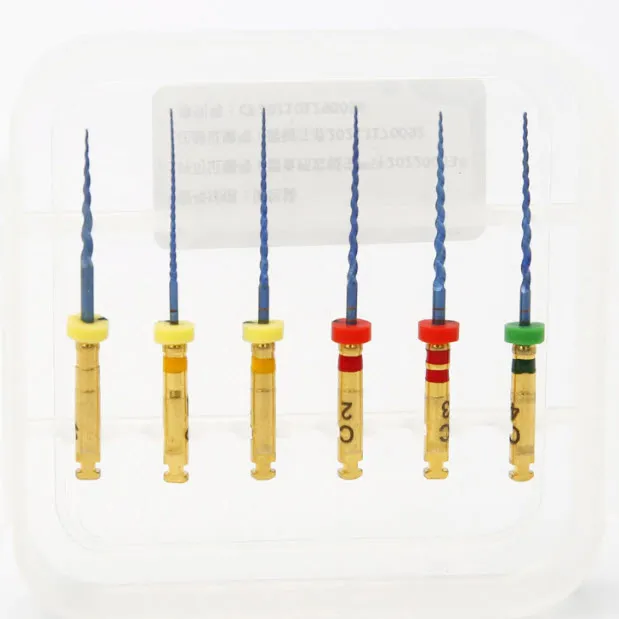
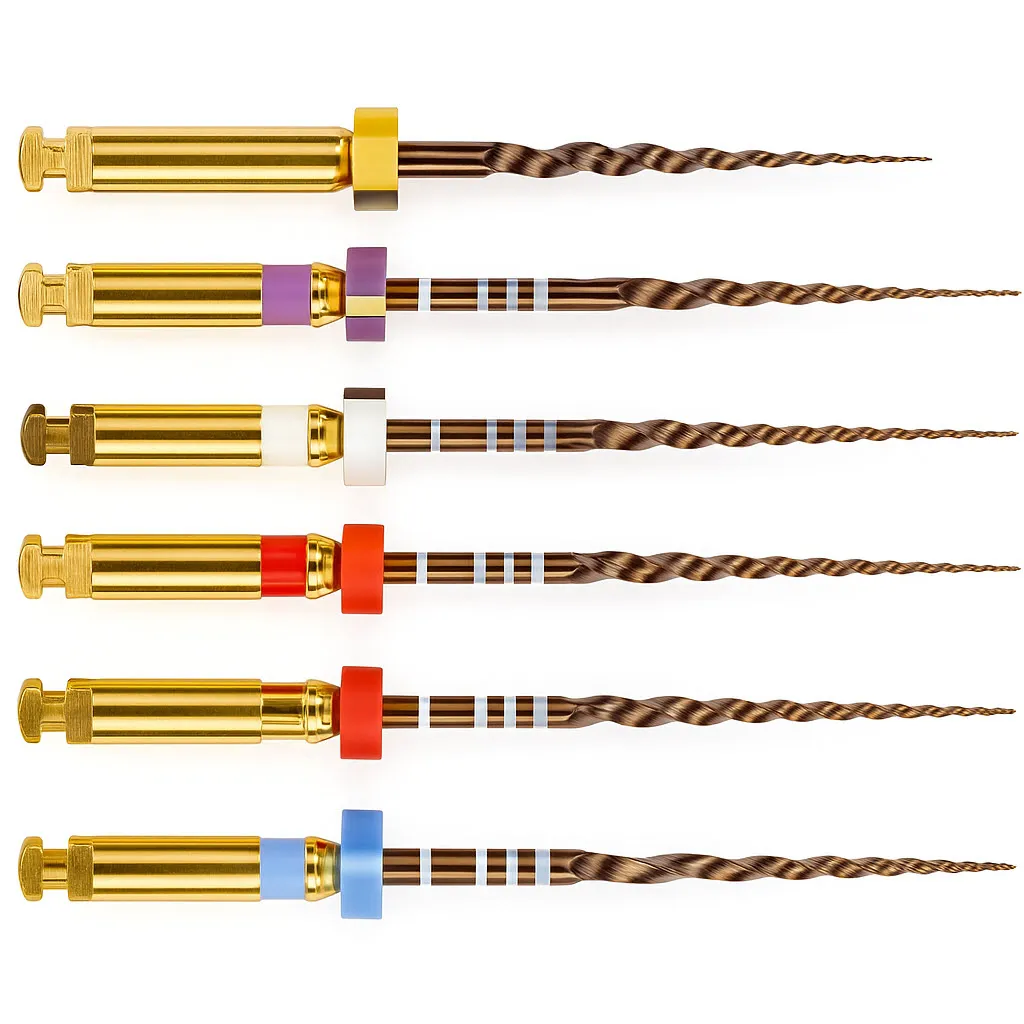
| Heat-treated rotary systems | IMD MPro Blue, IMD MTaper Gold, Layan ProTaper Gold-type sequences, Meta Biomed Aurum Pro | Shaping curved canals with more flexibility and fatigue resistance |
| Conventional NiTi rotary systems | EndoEdge, Dental Perfect and Medin sequences | Straight and moderately curved canals at lower cost |
| Torque-controlled motors | Woodpecker Ai Motor and Endopace, Eighteeth E-Connect S, Meta Biomed Endo Smart | File-library presets, torque limiting, auto-reverse, apex integration on some models |
| Chelating agents | MD-ChelCream 19% EDTA, RC-Cream, EDTA 17% solutions | Lubrication and smear-layer removal |
| Removal tools | Woodpecker ultrasonic broken-file remover tips E6 and E15 | Loosening a fragment under magnification |
| Failure mode | Where and when | Warning sign | Countermeasure |
|---|---|---|---|
| Cyclic fatigue | Apical third of curved canals; after repeated use | None; the file looks intact | Heat-treated files, smaller tapers, minimal time rotating at the curve, strict reuse limit |
| Torsional overload | Narrow or calcified canals; no glide path; excessive apical pressure | Unwinding of flutes, shiny stressed area, file screwing in | Glide path, torque-limited motor with auto-reverse, light pecking, lubricant |
| Combined | Curved and narrow canal worked with a used file | Either of the above | New file for every difficult canal |
| Property | Conventional NiTi | Heat-treated NiTi (gold, blue) | Stainless steel hand files |
|---|---|---|---|
| Flexibility | Moderate | High; some can be pre-bent | Low above size 20 |
| Fatigue resistance | Baseline | Higher in laboratory testing | Not applicable; used by hand |
| Cutting efficiency | High | High; some feel softer | Good for scouting |
| Cost per file | Lowest | Higher | Lowest |
| Best use | Straight and mildly curved canals | Curved and difficult canals | Scouting, glide path, apical gauging |
Stop, take a radiograph, and record the file size and level. In the straight coronal part of the canal, a fragment can often be loosened with fine ultrasonic tips under magnification and lifted out; beyond a curve, forcing removal risks a perforation and it is usually better to bypass the fragment with small hand files or to leave it and obturate to it. Tell the patient, document the decision and the reasoning, and follow up radiographically. A separated instrument itself is not a treatment failure; unresolved infection is.
Glide path and shaping:
Motors with torque control and auto-reverse, a chelating cream, and the removal tips for the day it happens anyway:
If you are still running rotary files on a motor without torque control, that is the first purchase; a motor with a file library removes the settings question entirely. Then a path-file kit and a heat-treated sequence for the molars, and a box of size 10 and 15 K-files for every case. Keep the broken-file remover tips in the drawer before you need them.
The speed and torque printed by the file manufacturer for that specific file, not a generic setting. Motors with preset libraries store them; on a manual motor, set them per file size. Auto-reverse and torque limiting should be on for every rotary sequence.
Reciprocation reduces the angle the file turns before it reverses, which limits torsional stress; it does not remove cyclic fatigue in curved canals. See our rotary versus reciprocation comparison for the trade-offs.
Manufacturers of many systems label them single use. Where reuse is practised, clinical guidance is to limit a file to a few straightforward canals, never reuse one that has worked a severely curved or calcified canal, and inspect under magnification before each use.
Stop, take a radiograph, and decide whether to bypass, remove or leave the fragment. Removal is easiest in the straight coronal part with ultrasonic tips under magnification; fragments beyond a curve are often bypassed or left, with the patient informed and the outcome monitored.
A chelating cream or gel lubricates the file and softens calcified dentine, which reduces the chance of the tip binding. It does not replace the glide path or the correct torque setting; irrigate with sodium hypochlorite between passes to clear debris.